Lighting Lux Calculations: Complete Guide to Illuminance Design, Lux Meters & LED Specifications
- Admin: IDAR Mohamed
- 14 Jun 2026
- 0
A lighting layout that looks right on paper can measure 180 lux on site. That gap between the design value and the actual reading is rarely a math error.
It comes from CU (Coefficient of Utilization) estimates that assumed cleaner walls and better room proportions than exist, LLF (Light Loss Factor) values taken from a textbook rather than the actual maintenance schedule, and no post-installation measurement because the contractor signed off before the ceiling tiles went in. By the time someone notices the space is dim, the access panels are sealed and the finishes are done.
Table of Contents
- Lux and Lumens: The Relationship
- Standard Illuminance Requirements by Application
- Recessed Lighting Calculation: Worked Examples
- Lux Light Meters: Selection and Use
- LED Lux Output and Efficacy
- High-Intensity Applications: 10,000 Lux
Lux and Lumens: The Relationship
Lumens and lux measure different things. Confusing them produces lighting systems that are either dim or wildly over-specified.
Lumens (lm): Total light output from a source. The figure on the lamp package.
Lux (lx): How many lumens land on each square meter of surface. The formula:
Where:
- E = illuminance in lux
- Φ = luminous flux in lumens
- A = area in square meters
A 3,200-lumen LED fixture over 4 m² delivers 800 lux, assuming even distribution. In a 10 m² room the same fixture produces 320 lux. The fixture did not change; the area did.
Working backward from a target:
500 lux in a 20 m² space requires at least 10,000 lumens from the fixture arrangement before losses.
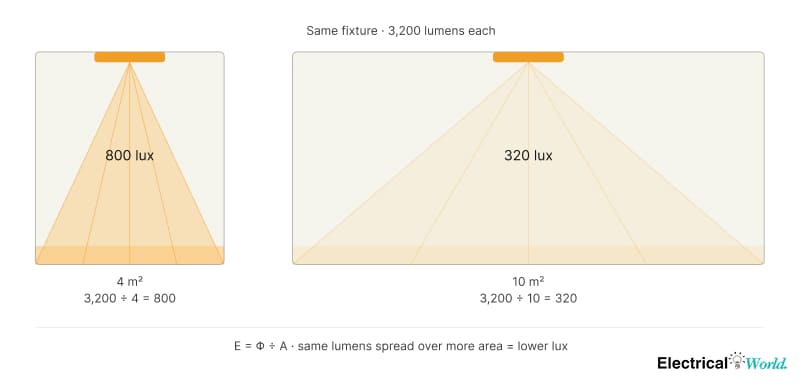
Figure: The same fixture output spread over more floor area produces lower illuminance at the working plane.
Standard Illuminance Requirements by Application
EN 12464-1 (Europe) and IESNA RP-1 (North America) define maintained illuminance at the working plane. Maintained means the design target holds after lamp aging and dirt accumulation, not just on day one.
| Application | Maintained illuminance (lux) | Reference |
|---|---|---|
| Emergency escape routes | 10 | EN 1838 |
| Storage and archives | 100 | EN 12464-1 |
| Corridors and stairways | 100–200 | EN 12464-1 |
| General office work | 300–500 | EN 12464-1 |
| Technical drawing, CAD | 500–750 | EN 12464-1 |
| Precision assembly | 750–1,000 | EN 12464-1 |
| Fine inspection, watchmaking | 1,500–2,000 | EN 12464-1 |
| Operating theatres (general) | 1,000 | EN 12464-1 |
| Surgical field | 10,000–100,000 | HTM 08-03 |
| Light therapy (clinical) | 10,000 | Clinical guidelines |
The common error in office design is targeting 300 lux for spaces that warrant 500. General office work sits at the boundary of both values in EN 12464-1. For any space where staff spend most of the day reading, writing, or working at screens, design for 500 lux.
Recessed Lighting Calculation: Worked Examples
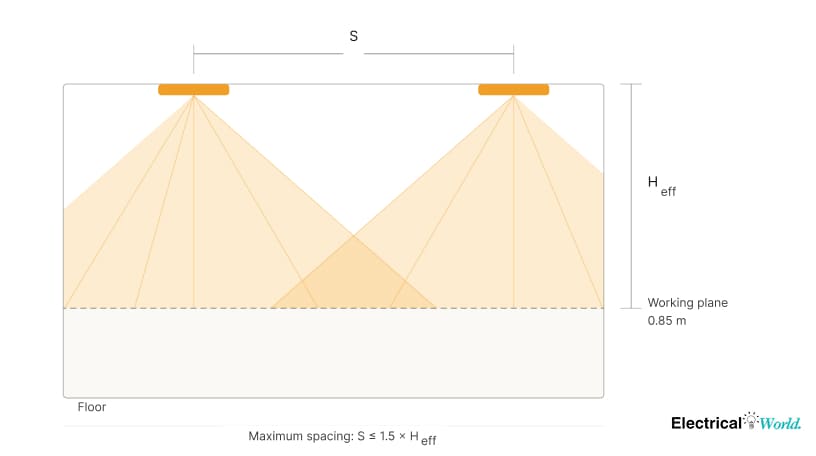
Figure: Maximum fixture spacing should not exceed 1.5 times the effective ceiling height above the working plane.
The full design method is the IES (Illuminating Engineering Society) zonal cavity method, which derives room geometry through a cavity ratio calculation. For standard ceiling heights and recessed general illumination, the simplified lumen method is accurate to within about 10%:
Where:
- N = number of fixtures
- E = target illuminance (lux)
- A = room area (m²)
- = lumens per fixture
- CU = Coefficient of Utilization
- LLF = Light Loss Factor
Coefficient of Utilization (CU)
CU accounts for room proportions and surface reflectances. For recessed LED downlights:
| Room conditions | CU range |
|---|---|
| High reflectances (ceiling 80%, walls 70%), square plan | 0.65–0.75 |
| Average reflectances (ceiling 70%, walls 50%) | 0.55–0.65 |
| Low reflectances or poor aspect ratio | 0.40–0.55 |
Use 0.60 for most commercial spaces unless you have actual reflectance data.
Light Loss Factor (LLF)
LLF covers lumen depreciation and dirt accumulation over the maintenance interval:
| Environment | LED fixture LLF |
|---|---|
| Clean (offices, hospitals) | 0.85–0.90 |
| Moderate (retail, schools) | 0.75–0.85 |
| Dirty (industrial) | 0.65–0.75 |
For LED systems in clean environments, 0.80 is a defensible default.
Example 1: Office Space
Given:
- Room:
- Target: 500 lux
- Fixture: LED recessed downlight, 3,000 lm each
- CU = 0.60, LLF = 0.80
Layout check: 3 m ceiling, working plane at 0.85 m, effective height = 2.15 m. Maximum fixture spacing: . A grid at roughly spacing fits within that limit.
Verify:
The design meets the 500 lux target.
Example 2: Warehouse Storage Bay
Given:
- Room:
- Target: 200 lux (EN 12464-1, storage)
- Fixture: LED industrial high bay, 15,000 lm each
- CU = 0.55, LLF = 0.75
Spacing check: At 6 m mounting height, maximum spacing = 6 × 1.5 = 9 m. A 4 × 5 grid places fixtures at 5 m × 6 m. Within limits.
Total installed load: 20 fixtures at 150 W each = 3,000 W. For circuit sizing of the LED branch circuits, see LED Circuit Breaker Sizing: Inrush Current Calculations.
Lux Light Meters: Selection and Use
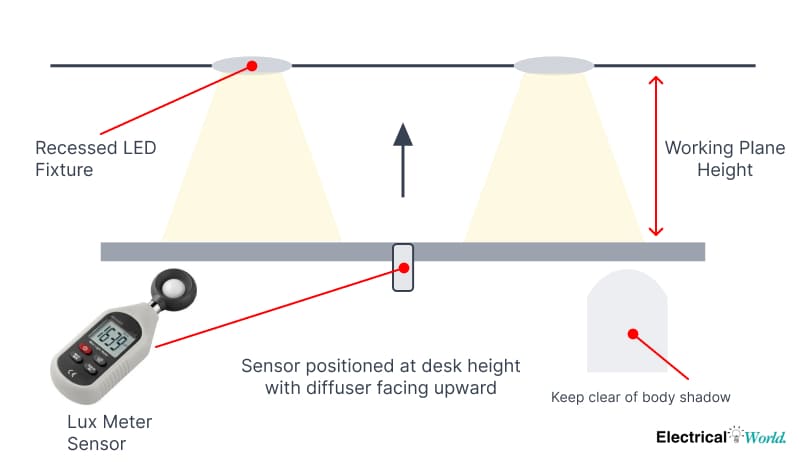
Figure: Hold the sensor at working plane height, clear of your body shadow, with the diffuser facing the light source.
A lux meter measures luminous flux per unit area at its sensor surface. The specifications that matter for field work:
Cosine correction: Light reaches a surface from multiple angles. A cosine-corrected sensor matches Lambert's cosine law, weighting oblique sources correctly. Without it, readings under fluorescent strips angled across a ceiling can run 20% or more below the actual illuminance.
V(λ) spectral correction: Human eye sensitivity peaks at 555 nm and falls off toward red and blue. A spectrally corrected sensor matches this curve. Standard photodetectors without V(λ) correction read 15–20% low under narrow-spectrum LEDs because the sensor overweights the blue peak that many LED products carry.
Range: 0–100,000 lux handles interior lighting through bright outdoor overcast conditions. Calibrating a 10,000 lux therapy lamp or measuring direct sunlight needs 200,000 lux range.
For LED measurement work, specify a meter rated to CIE (Commission Internationale de l'Éclairage) 69 Class A (f₁' ≤ 1.5%) or Class B (f₁' ≤ 3%). These ratings confirm the spectral correction is adequate for LED spectra, not just the fluorescent and incandescent sources that older meters were designed around.
Measurement Procedure
Hold the sensor at working plane height: 0.80–0.85 m for desks and benches, floor level for safety path illumination. Keep the measurement body out of the beam path. Take at least nine readings arranged in a 3 × 3 grid across the space and average them. A single center reading misses the dips between recessed fixtures entirely.
Divide the minimum reading by the average to get the uniformity ratio. Below 0.6 the distribution is uneven. Below 0.4, the bright and dark patches are visible and create visual discomfort. Fix spacing, not just fixture count.
LED Lux Output and Efficacy
LED spec sheets list lumens, not lux. Lux depends on mounting distance and beam angle, both of which vary by installation. The useful figures from the spec sheet:
- Lumens per fixture: Input to the calculation above
- Beam angle: Wider beams (100–120°) spread light more evenly at the cost of peak intensity. Narrower beams (40–60°) produce higher illuminance directly below and need tighter spacing for uniformity
- Efficacy (lm/W): Sets the running cost at any given lux target
Current commercial LED products range from about 100 lm/W at the lower end of the catalog to 200 lm/W for premium types. The office example above uses 3,000-lm fixtures at 100 lm/W: 30 W per fixture, 420 W for 14 fixtures. The same lux level from fluorescent T8 at 85 lm/W would need about 35 W per fixture, 490 W total. That 70 W difference runs continuously across thousands of operating hours.
CRI does not affect lux. A CRI (Color Rendering Index) 70 fixture and a CRI 95 fixture can read identically on a lux meter. CRI determines how accurately colors render under the source. For office work, CRI ≥ 80 is the accepted floor. For printing inspection, food retail, or art display, CRI ≥ 90.
High-Intensity Applications: 10,000 Lux
Getting to 10,000 lux requires fundamentally different equipment from what goes in a standard office ceiling.
Light Therapy Devices
10,000 lux is the clinical standard for bright light therapy, established in research on Seasonal Affective Disorder treatment. At that intensity, effective sessions run 20–30 minutes. At 2,500 lux, reaching the same therapeutic result takes roughly two hours.
Devices like the Carex Day-Light Classic Plus are calibrated to deliver 10,000 lux at a fixed distance, typically 12 inches (30 cm) from the diffuser surface. The inverse square law applies directly: move to 24 inches and the illuminance drops to approximately 2,500 lux. The specified distance is not a recommendation. It is what makes the 10,000 lux rating real.
info
Light therapy devices rated at 10,000 lux should filter UV output. Therapeutic benefit comes from high-intensity visible light. Confirm UV filtration in the product specification before use.
These are calibrated for direct face illumination at a fixed distance and position. Using one as a room light accomplishes neither decent room illuminance nor effective therapy.
High-Output Industrial and Medical Lighting
Precision inspection stations, color-critical manufacturing, and dental operatories commonly specify 1,500–3,000 lux, achieved with high-output LED panels mounted close to the work surface. At 3,000 lux over a 0.6 m × 0.6 m inspection bench, the fixture needs to deliver roughly 1,080 lumens to that area, which a standard 300 × 300 mm LED panel handles without difficulty.
Surgical operating fields sit in a different category: 10,000–100,000 lux at the surgical site, shadowless from multiple angles, specified under HTM (Health Technical Memorandum) 08-03 (UK) or equivalent medical device standards. These are not standard electrical products.
Measure after installation, before the ceiling is closed. CU and LLF are estimates. The actual space may have darker wall finishes, higher ceilings, or storage racking that alters the assumed reflectances. Finding a 15% shortfall when the access panels are still off is manageable. Finding it six months later, with a finished ceiling and occupied space, is not.
FAQs
What is the difference between lumens and lux?
Lumens measure the total light output from a source. Lux measures how much of that light lands on a surface per square meter. A 3,200-lumen fixture over a 4 m² desk produces 800 lux. The same fixture in a 10 m² room produces 320 lux. The source did not change; the area did.
How many lux do I need for an office?
EN 12464-1 and IESNA RP-1 both specify 300–500 lux for general office work. Task areas such as drawing boards or computer workstations need 500–750 lux. If measured illuminance falls below 300 lux at the desk surface, add task lighting before replacing the ceiling system.
What is a 10,000 lux light used for?
10,000 lux is the clinical standard for bright light therapy, established for treating Seasonal Affective Disorder. At that intensity, effective sessions run 20–30 minutes. At 2,500 lux the same therapeutic effect takes roughly two hours. The Carex Day-Light Classic Plus and similar devices are calibrated to deliver 10,000 lux at a fixed distance, usually 12 inches from the diffuser.
How do I calculate the number of recessed lights for a room?
Use: N = (E × A) ÷ (Φ × CU × LLF). For a 40 m² office at 500 lux with 3,000-lumen fixtures, CU = 0.60, LLF = 0.80: N = (500 × 40) ÷ (3,000 × 0.60 × 0.80) = 13.9, round to 14 fixtures.
What should I look for in a lux meter?
A cosine-corrected sensor, V(λ) spectral correction, and a 100,000 lux range covers most interior and outdoor applications. For LED-specific work, verify the meter meets CIE 69 Class A or Class B. Standard photodetectors can read 15–20% low on narrow-spectrum LEDs.
Related Posts
- LED Circuit Breaker Sizing: Inrush Current Calculations & Real Examples
- Wire Size Calculator: Complete Guide with Single Phase, 3-Phase & DC Calculations
- Understanding Induction Motors: Working Principle, Calculations, and Applications
- Transistors Explained: BJTs, MOSFETs & IGBTs with Real Part Comparisons
- Servo Motor vs Stepper Motor: Which One Actually Belongs in Your Build?
Helpful Calculators
Credits
- Photo by Alexis Presa on Unsplash
⭐ Was this article helpful?
IDAR Mohamed
Electrical Engineer
Electrical Engineer specialized in power systems, electrical installations, and energy efficiency. Passionate about simplifying complex electrical concepts into practical guides. (University of applied sciences graduate, with experience in HV/LV systems and industrial installations.)
- Sensors and Measurement
- Electrical Testing and Calibration